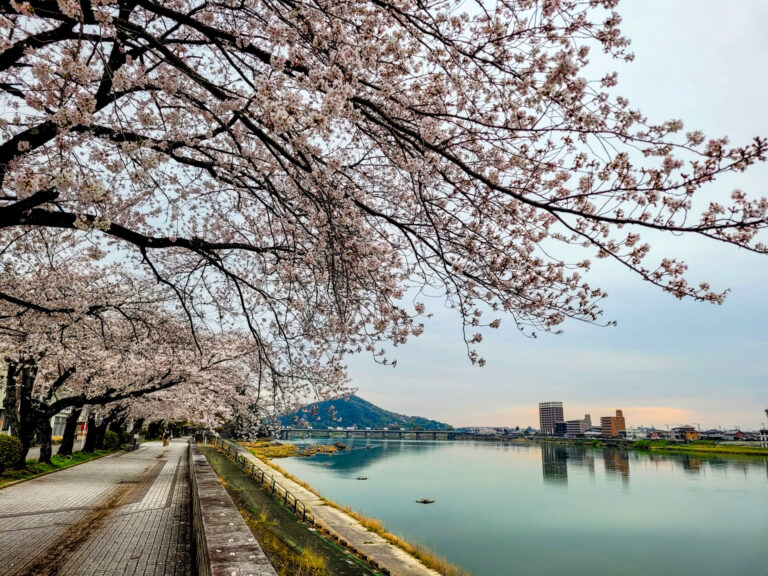

Two years ago, I spent an amazing 4 days in Japan wandering under the heavily-laden boughs of cherry blossoms in full bloom. This wasn’t the first time I had seen these trees in bloom, for they are common in New Zealand as well.
But seeing them in Japan, alongside the ancient shrines and temples, and experiencing the cultural practice of hanami firsthand? That hits way differently.
If you’re reading this, I probably don’t need to give you all the reasons why seeing cherry blossoms in Japan should, in fact, be on your bucket list. You already know why.
I’m just going to skip right ahead and tell you all the things I wish I knew when I was planning my own trip.
In short: It’s a bit more complicated than just flying in on the dates that a website or tour agency gives to you.

Decide broadly which part of Japan you want to see cherry blossoms in
This should be the first thing that you do, as it will affect everything else.
Japan is a very long country, with multiple big islands. And because cherry blossoms are very seasonal, there is no single “cherry blossom” period for all of Japan.
Generally, the “cherry blossom front” starts south in Kyushu and gradually proceeds north to Hokkaido.
So, if you are planning to visit Hokkaido, cherry blossoms will typically be predicted to bloom a whole month later than in Tokyo, for instance. Even within the main island of Honshu, each city has a different time for peak bloom forecast.
You’ll need to decide roughly which area of Japan you are going to be in, then check the forecasts.

Check the forecast from Japan Meteorological Corporation, but take it with a grain of salt
Every year, the JMC (Japan Meteorological Corporation, aka the primary authority on all things related to cherry blossoms) releases their cherry blossom forecast dates. The first forecast for 2026 was released on 18 December 2025, and it is continually updated.
It’s important that you check these forecast dates regularly, but equally important that you don’t rely completely on it.
This is because the flowering dates depend heavily on seasonal changes and the weather, and there is no way to know what the weather patterns will be like so far in advance.
You should also note that the dates given are usually the predicted first flowering dates, not the full bloom dates.

When cherry blossoms start to bloom, not all of the buds will open at once. The process is gradual, and it takes roughly 1 week from first blossoms to full bloom (mankai).
Full bloom is the period where the blossoms are at their peak, the trees looking all beautiful and fluffy, and this is usually what you’ll see in photos or videos of cherry blossoms.

Full bloom lasts for only 1 week, usually. And then the blossoms start to fall, and within the next week, they are replaced by budding green leaves. This can happen sooner if there is heavy rain or high winds.
So, herein lies the issue. You’re basically targeting a period of 1 week, but this week can shift up to 3-4 weeks depending on the weather.
Every few weeks, or more often when the date draws near, JMC will revise their predictions and release a new forecast. Starting from around March, forecasts are released almost daily.
The JMC forecast will become very accurate a few days before full bloom, but most of us can’t afford to plan our trips at the last minute, so we need to do some guesswork.
And, that is why I’d recommend that you…
Plan to stay for at least two weeks
If you stay for 1 week or less, you are statistically unlikely to see much of full bloom unless you are extremely lucky or you booked your flights at the last minute.
The longer you stay, the more likely it is that you’ll catch it. If you can stay for 4 weeks, you will certainly be able to see full bloom for a specific location (for Nagoya, Osaka, and Tokyo, this would be the last two weeks of March and the first two weeks of April).

Most of us can’t afford to take 4 weeks of leave, however, so I think 2 weeks is the sweet spot. If you book 2 weeks in Japan around the forecasted times 3 months in advance, you have a good chance of seeing blossoms as long as your itinerary is flexible.
You don’t have to just sit around the cherry blossom hotspots the entire time, hoping and waiting. You can plan your trip as usual, including looping around the island to locations that have different cherry blossom timings or places that have no good viewing locations, as long as you…
Book refundable accommodation
Booking refundable accommodation is how we were able to alter our trip at such short notice to catch the cherry blossoms around Nagoya.
We were originally slated to spend the later part of our trip in Nagano, but then the last-minute forecast showed that Nagoya trees would be in full bloom the day we were scheduled to leave.

If we had gone to Nagano as planned, we would have missed out completely. Nagano is at a higher altitude and latitude, so the cherry blossoms there would have bloomed later.
But our accommodation in Nagano was refundable, so we cancelled it, and booked new accommodation in Inuyama.
Download the “Sakura Navi” app
Let me preface this by saying that I’m not affiliated with the Sakura Navi app and I don’t get a commission when anyone buys it.
I’m still going to recommend it because I think it’s essential.
See, cherry blossom (sakura) flowering is very very specific to the location. If you’re even a bit higher in altitude, or in a slightly different location, the peak bloom time will differ.
This means that even if the blossoms 50km away are at peak bloom, the blossoms in the location that you are going to might not be.

With the app, you can check the specific peak bloom dates for every known sakura viewing location. You can also get notifications when you are close to a viewing location, and browse a map of locations, allowing you to discover less popular locations that aren’t usually written about.
It runs on JMC data, so you’ll always get the most updated information. When you are very close to the date, it is extremely accurate.
This app was how we found out about blossoms in Enakyo and Inuyama, and how we knew that those specific blossoms were going to be at peak bloom during the few days that we had remaining in Japan.
Yes, it costs money ($7.99 for Android and $4.99 for iOS last I checked). Personally, though, with the cost of flights and accommodation, I’m not going to complain about spending $8.
They release a new app every year (for some reason…), so don’t be alarmed to see the low number of downloads.
You can download the 2026 version for Android and iOS on the Sakura Navi website.
Find a less popular cherry blossom viewing spot
Japan is an incredibly popular tourist destination, and cherry blossom season is the most popular season for international tourists to visit Japan.
Needless to say, the popular viewing locations can be insanely packed.
Kyoto in particular is a major hotspot for cherry blossom viewing; and with its stunning temples and Edo-period architecture, I can see why people love seeing blossoms with Kyoto as the backdrop.
But also, having experienced the crowds in Kyoto before full bloom rolled around, I didn’t think that I wanted a repeat (and potentially even worse) experience of that. That’s how we ended up in Inuyama, instead of returning to Kyoto.

If you’re less averse to crowds, you can try the popular locations (and let me know how it goes!). But also, I think everyone should experience a less-known spot at least once.
Being almost completely alone in an entire street lined with blossoms is a treat that I’ll remember for the rest of my life.
You can use the app to browse through viewing spots in full bloom throughout Japan, and just pick one that’s not in Kyoto, Osaka, or Tokyo.
Or, you can read my guide to viewing cherry blossoms off the beaten path.
Check the dates of major festivals
Due to the cultural significance of cherry blossoms in Japan, dozens of festivals spring up all over the country during cherry blossom season.
This can either be an amazing experience, or something to avoid, depending on how you feel about big festivals. There are often performances, yatai (food stalls), and lots of sakura-themed goodies.

We happened to be in Inuyama during Inuyama Matsuri. While the festival itself was an incredible cultural experience, there were also significant crowds during the day of the festival. Accommodation prices, already high during cherry blossom season, spiked even further on that weekend.
Either way, you should check the dates of major festivals beforehand so you can make an informed decision. Here is a list of the festivals being held in various parts of Japan in April.
Consider other types of blossoms
While cherry blossoms are the most popular by far, they aren’t the only kind of blossoms you can see in Japan.
Some of the other alternatives are:

- Plum blossoms (ume). A brighter pink with a different petal shape and structure, ume look quite similar to sakura from afar, but very distinct up close. They bloom much earlier, typically from January – March.
- Peach blossoms (momo). These look extremely similar to sakura, except that the tips of their petals are not notched. They typically bloom one month earlier than sakura, i.e. from February to March.
One of the main advantages of going for ume or momo is the different bloom timeline. If you want cheaper flights and accommodation, or you want to beat the crowds, they can be a good alternative.
Questions, comments, suggestions? Let me know below!