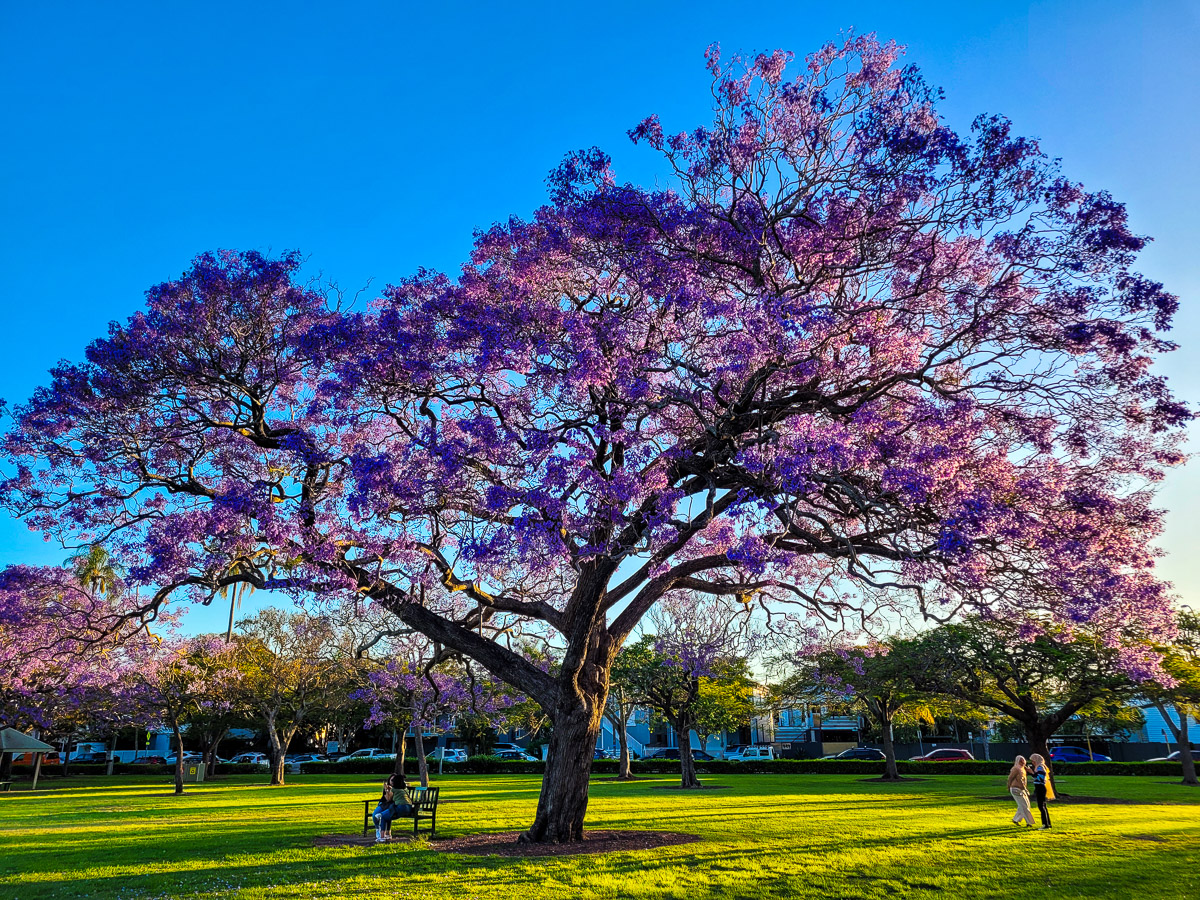
One of my favorite things about living in Brisbane is watching the jacaranda trees come alive with brilliant shades of violet and pink each spring. It’s a big event around these parts – the University of Queensland’s official color is purple, and rumor has it that if a jacaranda petal falls on your head, you’ll fail your exams!
I’ve lived here for the better part of 8 years now, and no matter how busy I am when October rolls around each year, I’ll make time to visit at least a few of the top viewing spots. It certainly helps that there’s a secret spot right next to my neighborhood that few people seem to know about – more on that below.

Originating from South America, the jacaranda tree is technically considered an “invasive species” in the state of Queensland, due to the fact that it can out-compete native species. Just like lupins in New Zealand, they’re essentially a weed, but a very pretty one!
With jacaranda season right around the corner, here are my tips for checking out these gorgeous blooms in Brisbane.
When can you see jacarandas in Brisbane?
Want to see jacarandas in full bloom? You’re in luck!
Jacarandas have much longer peak bloom times than cherry blossoms, which are notoriously finnicky. While the window for peak bloom is roughly a week for cherry blossoms, in jacarandas it can last for four weeks or more!
The trees also aren’t barren for long periods of time – their leaves fall only shortly before they burst into bloom. So if you see a jacaranda tree with leaves on, don’t be afraid that you’ve missed the blooming period.
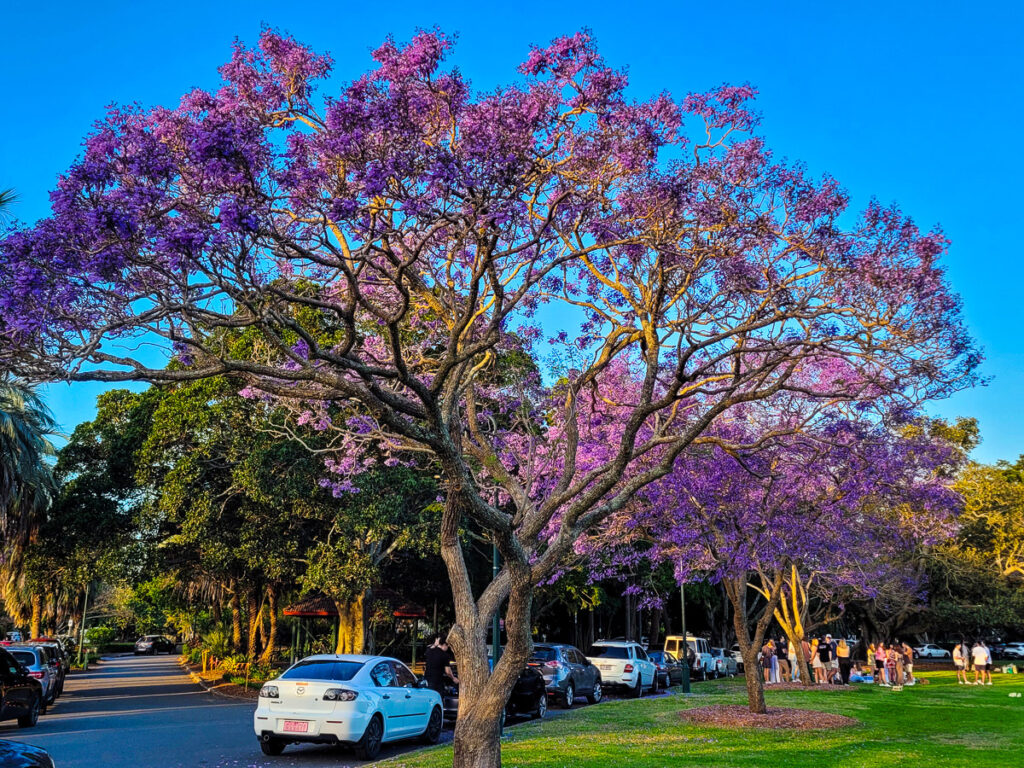
There are two types of jacarandas that are typically found in Brisbane. I’m not a botanist, so I’ll refer to them as the purple type and the pink type. Besides the obviously different color, they have different peak bloom times.
Purple jacarandas
Purple jacarandas are the more common and (in my opinion) the more stunning variety. Most of the top viewing locations in this post feature purple jacarandas.
Glancing through my many, many photos of purple jacarandas, most of the full bloom photos were taken in October, with a dense cluster around the middle two weeks. So if you’re planning to do a photography shoot or are timing your visit to Brisbane around these beauties, I’d recommend that you aim for the middle of October.

However, they often start blooming in September, so if you happen to be around at the end of September you might get lucky. In November, you’ll often get a mix of green leaves with flowers, although the fallen petals are a magnificent sight on the ground.
Pink jacarandas
Pink jacarandas are less common and you won’t see large numbers of them in one spot, so I wouldn’t recommend timing your visit for these.

However, if you do still want to see them, they bloom a lot earlier than the purple jacarandas. Peak bloom is typically in August, and by late September they have regained their green leaves.
Where are the best jacaranda viewing spots in Brisbane?
The University of Queensland (St Lucia campus)
The University of Queensland’s St Lucia campus is the most popular jacaranda viewing spot in Brisbane, and for good reason!

Juxtaposed against majestic sandstone buildings, the violet hues of jacarandas in full bloom are an incredible sight. It’s not just reserved for UQ staff and students, either – visitors are welcome and most outdoor areas are accessible to the public.
On weekends, parking in the UQ St Lucia campus is free. We usually park opposite the UQ Law School and walk through to the courtyard. You can also take the bus or ferry.

Once you’re in the courtyard, follow the signs to the lake, and then do the circuit around the lakes towards the Eleanor Schonell Bridge.
New Farm Park
Every Brisbanite’s favorite weekend picnic spot, New Farm park is at its best during jacaranda season. By October, the weather is warm enough for the rose gardens to be in bloom at the same time, so the entire place is full of vibrant colors.

Create your own charcuterie board at the supermarket or one of the many farmers’ markets in Brisbane, then head over with a picnic rug and maybe a frisbee. Stake out your spot under one of the many jacaranda trees lining the periphery of the park, and spend a lazy afternoon there.

Just like UQ, New Farm Park is by the river, so it’s serviced by both the bus and the ferry. There’s plenty of free parking nearby on weekends, but it fills up fast, so be prepared to park further away. On weekdays, street parking is mostly paid, but to the best of my knowledge the park’s (very small) carpark is free, if you can find a spot.
Eastern side of Kangaroo Point
When you say “Kangaroo Point”, most people think about the western side, where you can have a drink or a BBQ atop high cliffs with a sweeping view of the Brisbane CBD skyline.
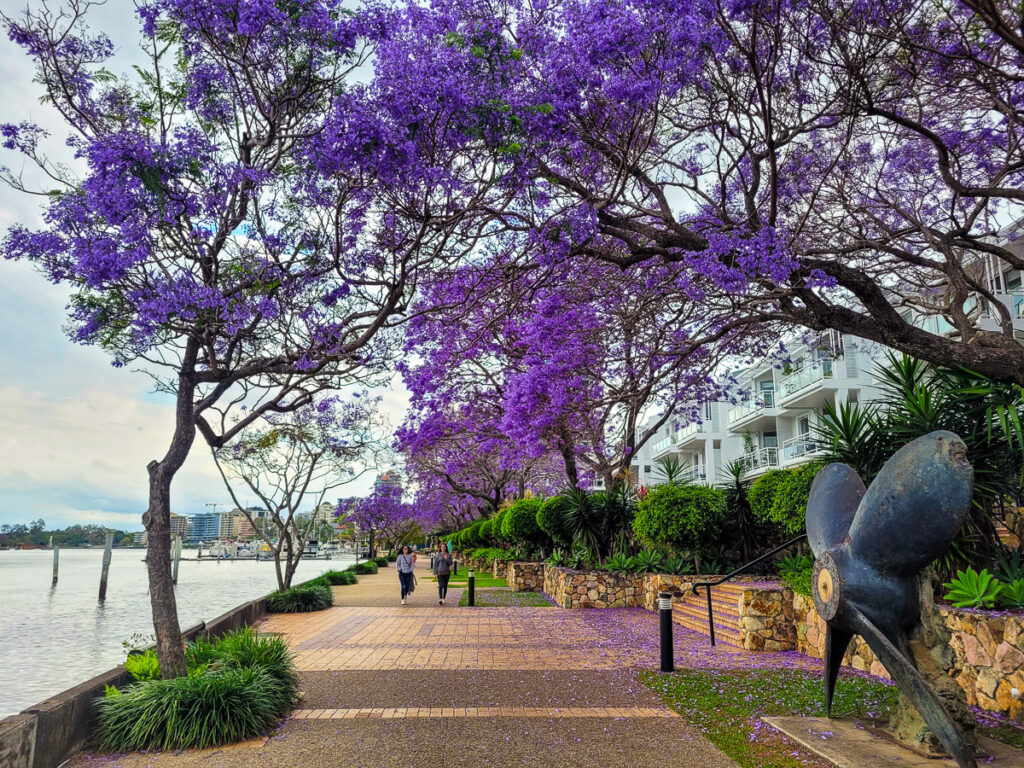
But the eastern side, near the marina, is the place to be during jacaranda season. Start at Kangaroo Point Beach (and I wouldn’t take the term “beach” too seriously here), and head south past Medley. You’ll come across a riverside trail next to residential areas, and both sides of the trail are lined with jacaranda trees.
As a side note, I’m not sure if I’m imagining things, but the purple jacaranda trees here seem to flower a little earlier than most of their brethren. I consistently see trees in full bloom here in late September, which is somewhat rare.
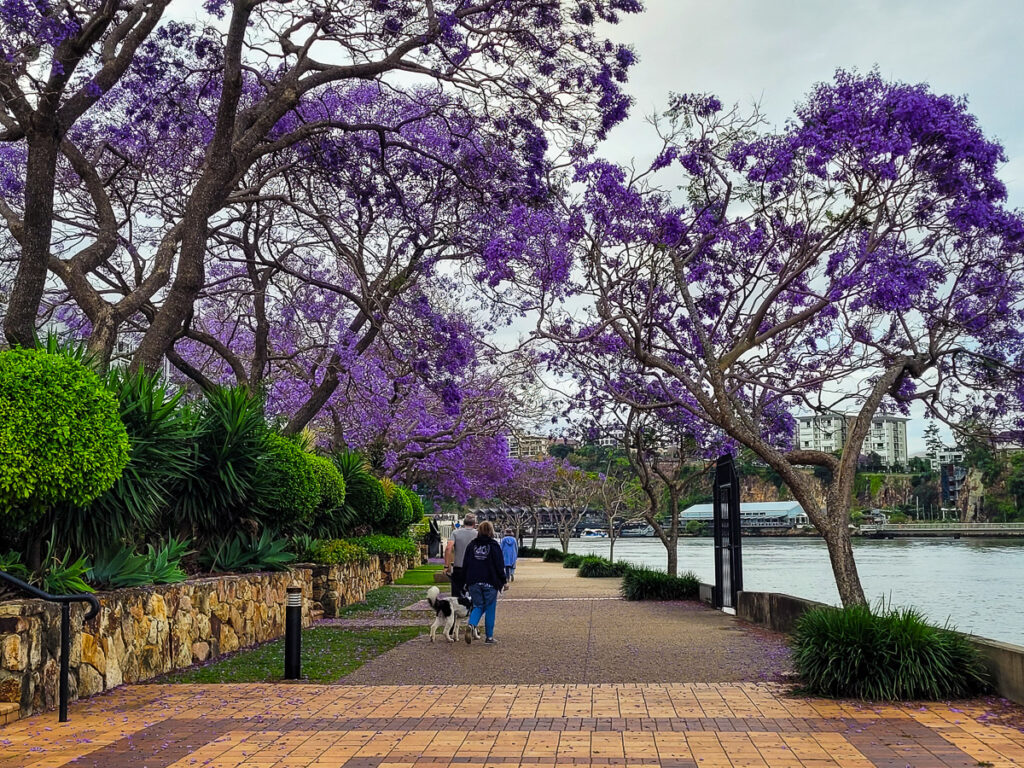
Newstead Terrace
Hardly anyone seems to know about this hidden spot, and I honestly thought twice (actually, thrice) before deciding to write about it!
Newstead Terrace, the residential street just parallel to the riverside trail, is one of my favorite places for a morning or evening walk. Unlike the locations above, it’s not pedestrian-only, but it’s such a quiet street that you won’t come across many cars.

Most of the trees alongside the road are jacarandas, and there’s a ginormous jacaranda tree next to a purple-colored building on the corner of Austin St.
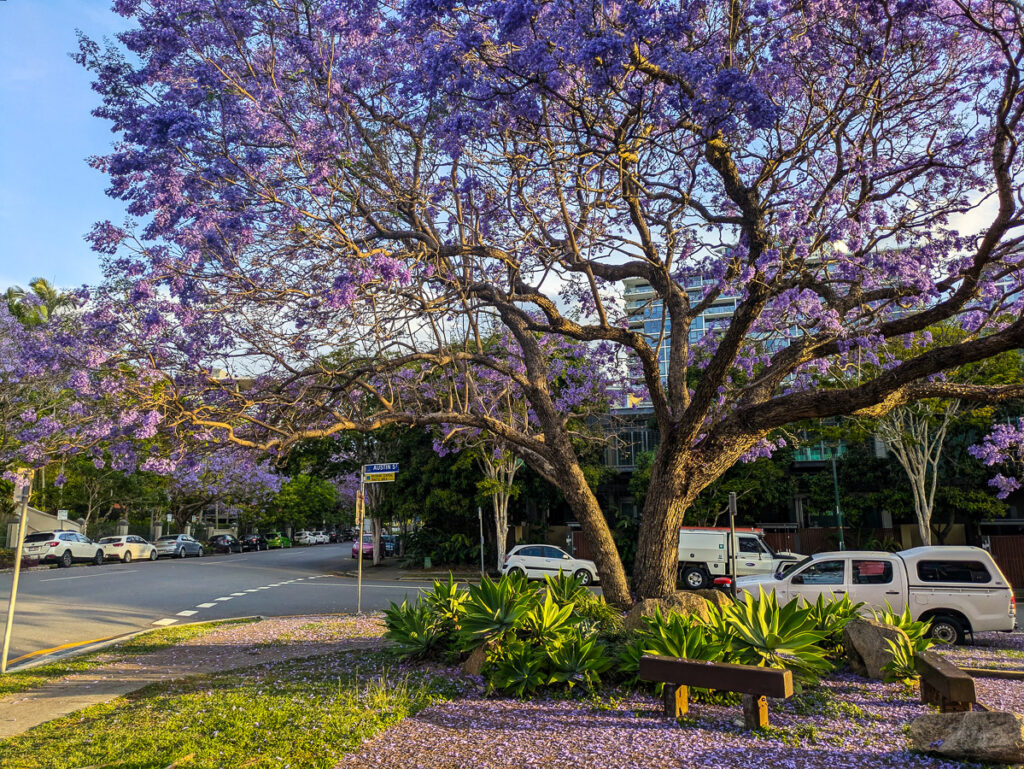
Like Kangaroo Point, this street is mainly residential, so please try to be quiet and respectful of the local residents.
Roma Street Parkland
Located in the heart of Brisbane CBD, Roma Street Parkland is absolutely bustling on weekends.
It doesn’t have long jacaranda-lined avenues like the other spots, but it has some very large trees that are a phenomenal sight in full bloom.

Make sure to drop by the Spectacle Garden before you leave – it doesn’t have jacarandas, but it’s the prettiest garden in Brisbane.
Brisbane isn’t the only city in Australia that turns purple every October. Sydney, Adelaide, Melbourne and Perth all also have great viewing spots — here’s a more general guide on where to see jacarandas in Australia.
Happy jacaranda spotting!